
The Artist’s Story
Standing alongside a roomful of my paintings, watching the public wander their way around, it has become more and more clear to me that people’s enjoyment of a painting is multi-factorial, and the significance of those different factors varies between each person.
I recently visited, full of expectation and hope, a museum exhibition of Gwen John.
It was full of information, plenty of people, but it was deeply dull.
On their own, the paintings were bland and uninteresting. They would qualify as technically competent, but I cannot imagine anyone wanting to buy one to enliven their walls. And yet - here we are 100 years later studying her life story. Maybe exhibitions in museums follow criteria that are different to those used by people deciding whether or not to buy a painting?
There is no doubt that some of the criteria used in the buying choice are very straightforward – they judge what they see in the most direct of terms – Do I like the image? Are the colours pleasant to look at? and - from experience of my own exhibitions: Would it match the sofa?
I have also observed that some spouses will often stand back and set aside their own opinions if their partner is keen.
Then there is the quality of the work – quality in the execution of the painting and in its’ presentation, to the extent that a good quality frame may be even more important whether or not I have succeeded in capturing the essence of the subject.
I have come to appreciate that everyone has their own taste in colour and style. These preferences are clear in that way we dress – and, most important in choosing artwork – in how we furnish and decorate our homes. [To digress – I often wondered why anybody buys ‘art’ from huge department stores, but now I realise that it is solely to fill a space on a wall in their home and to do so in a way that ‘will go’ with everything else in the room. The image is probably mildly pleasant and of something at least vaguely familiar to the buyer, and it is non-controversial in any way: it is ‘safe’.]
But that leads to the next factor – there should be something to say about the picture, or about something the picture says to the viewer, to give the new owners a response if anyone comments on it.
Western white men (like me, ‘wwm’) have dominated the world, including the art world for so long that rightly there is still a post-modern post-colonial trend to explore and appreciate art that comes from non-wwm sources. Any comment from (wwm) me on this is likely to come across as patronising. Suffice to say that I have spent many many hours of my corporate life promoting cultural change under the wholly inadequate banner of ‘equalities’; my personal mindset is very liberal, and I strongly believe that it was (and still is) wholly wrong for artists to have to fight harder for appreciation because of their personal profile. Which might all contribute to the interest in Gwen John - a woman in a man’s world.
My point here is – artists must present themselves as a ‘brand’, and at this time there seems to be an imperative to include details of that personal profile so that the artwork can be categorised as being representative somehow of a particular genre as it was produced by someone of that profile.
Over the last 100 years, in the post-religious and increasingly democratic world, artists have had a great impact representing and stimulating the changes going on across society. Each wave of change has been accompanied or even stimulated by an ‘avant-garde’ art movement. (“avant-garde” literally means ‘ahead of the crowd’). Fantastically talented artists – Cezanne, Matisse, Picasso, Pollock ….. who could each have earned a comfortable life producing extremely well painted traditional pieces, risked all by concentrating their effort on works which were not ‘safe’, which did not conform to the then-contemporary forms praised by critics.
The irony today is that the current contemporary forms praised by critics include experimental uniqueness and the equal but opposite backlash to that would be to revert to chocolate-box traditionalism. But that is such a densely populated field that an artist needs their own brand, backed with their own personal story in order to stand out.
It has taken me some time for this realisation to dawn – my attitude up to then was that the picture should stand or fall on its own merit: why does it matter whether it was painted with a knife, a 6” brush or a chisel? Why does it matter if the artist comes from Pontypool, or is left-handed, or mad?
A piece of music is judged on its own merit – nobody is too concerned about the composer’s life story or whether or not the sounds it contains are ‘like’ something in the real world, as the music itself is now in that ‘real’ world.
We can hear that piece of music in our ears exactly as the composer intended, wherever we are in the world at any time.
But our experience of a piece of art, for most of the time, is restricted to a representation of it limited by the technology of a tiny screen – rather like first hearing that piece of music through someone humming it?
So, why are we obsessed with an artist’s story, their gender, race or the challenges they have faced in life?
Why does it matter if a landscape painting is a ‘good’ representation of a particular place?
Part of the answer is about perspective or the viewpoint. Again, I initially understood those phrases to relate to the presentation of the picture – does the fading into distance work? Where was the artist standing? How about playing with different viewpoints of the same subject in the same piece?
I actually experience anger when a commentator proudly declares they have found the exact spot where Cezanne was standing when he painted a particular canvas - Cezanne worked hard to make the painting the important thing in itself, not as a capture of a view, especially as the view changes from one glimpse to the next as the sun and wind alter nature.
But of course these issues also relate to the artist. What I put into a painting is my interpretation of what I see and so it is ’from my point of view’. Then what I see and what I present has been channeled and filtered through my personal set of experiences and values and so (according to this notion), my work can justifiably be presented as coming from a right handed man (wwm) raised in Edinburgh and living in Pontypool.
- I remain doubtful. I stay with a conviction that it is the painting that is judged, but the fact is that the artist’s story matters, even if my work looks nothing like that of any other artists’ of the same profile.
OR – could it be that actually it is quite difficult to distinguish really good art from the vast arrays of it that are being generated every day, and that hence those ‘peripheral’ issues are what makes an artist ‘hot’ and collectable?
30 June 2026
Keeping Up ……. NFT eh?
I will begin with a confession.
When I was at school, there were no calculators.
Computers? Nope, Bill Gates was a lad and Microsoft didn’t exist.
If we had complicated things to do with numbers, we used a slide rule, or “Log Tables”.
Which is to explain that I have seen the world change and I positively welcome change.
There is a label: “FOMO”
Fear Of Missing Out.
So when I began to receive messages on social media along the lines:
“I LOVE your art, you are sooo talented. I really want to buy it as NFT”
First of course there are waves of warm glow – how fabulous, this person in Florida loves my work. Every artist enjoys this sense of validation.
But ten seconds later, having checked among artist e-contacts, I block the messenger in light of dire warnings about scams.
This has been my strategy for a few years now, as with pleas for funds from relatives stuck in foreign lands, but curiosity is getting the better of me.
How is it that these scammers are so prolific?
What do they know that I don’t?
One of the joys of today’s world is that if you have any questions about anything, the answer lies under the keyboard.
And I find that there is a whole ‘metaverse’ out there which is more real today than log tables.
“NFT Fine Art” generates 22 million search results.
The scammers thrive because there IS a marketplace where NFTs are bought and sold as commodities, and royalties are paid to the artist every time one of their works is exchanged.
Wow, lets get in there.
Or maybe not.
That marketplace exists in the virtual world of digital electronics, and the whole system relies on concepts designed for that world which are completely unknown to earthlings like me.
But I had to learn French grammar once, so how hard can it be to understand what a ‘blockchain’ is?
And anyway, Damian Hirst moved along from diamonds and formaldehyde into NFTs …..
So lately I have spent a little time trying to get to know a bit about this metaverse. Evidently there are people around the world who gamble, using weird ‘cryptocurrency’, by buying and selling NFTs, obviously hoping that they sell for more than they cost to buy – a basic instinct known to man ever since communal living was replaced the drive to collect gold.
Of course they don’t use gold now, the fave currency used for these exchanges in the ether is called …… Ethereum.
So – am I going to dive in to this Metaverse?
No.
And why not?
Fear.
Our ancestors were afraid of wandering off into the dark forest. They knew that people who did that didn’t always come back. This ‘metaverse’ is the dark forest for me (and, btw, this has nothing to do with any social media company.)
It was created by people who honed their skills designing video games. They use computer code which is far beyond my French grammar. It is a dark forest where rules, laws and regulations may or may not be observed, and which is inhabited, amongst many who are entirely honest and well-meaning, by some bandits whose aim is to steal. It is likely that the nice message about my lovely paintings didn’t actually come from a respectable person in Florida, but originated on a keyboard in a dark cave somewhere deep in the forest. The follow up to the enquiry about NFTs is for me to click on a link they helpfully sent me to open an account so that I can begin to accumulate piles of Ethereum (gold?), just fill in the bank details here. Really?
I paint. I create art that I want people to enjoy looking at.
I admit I am still confused about one aspect of this NFT marketplace -
What happens to the physical piece I have painted?
Hirst apparently offered to destroy those of his that were bought as NFTs so that the owner of the digital work could be sure that what they owned was unique. I certainly don’t want to destroy paintings myself even if I am going to receive 0.0001 ETH any time the digital copy is exchanged. (And, OK, I know this is maybe irrational as I have no control over what purchasers of my paintings do with them – I think destruction is unlikely.) This is what the Blockchain is – a (digital) ledger permanently linked to the NFT and accessible by the artist originator to keep track of all the exchanges of this valuable commodity forever. I have absolutely no idea about where the paintings I have sold to date are now. Would I want that information just because it is technically possible?
There are ‘Immersive art’ exhibitions where digital works are displayed on multiple screens creating a whole room that is completely covered by moving images of electronic (NFT) artwork.
I saw this on: https://seriousartonly.com/.
Frankly it reminded me of 1960s psychedelia gone large, but it is a whole new (or at least new to me) glorious artform, which only exists digitally.
Art has always come in many different forms and this new form flows from computers. I suspect that there are fewer artists working in that field than there are holding brushes – less competition?
There has been a hugely popular travelling circus showing van Gogh paintings in this immersive way, and the reviews all seem very favourable.
But despite the messages about my amazing talent, I am afraid it is not realistic to think that my paintings stand in comparison with works of Hockney and van Gogh, but I feel good when I think of one of my paintings hanging on a wall giving people pleasure when they look at it.
Good luck to any e-artists who DO launch into the metaverse, and good luck to the NFT buyers and sellers who want to make Ethereums through trading, but I am making a conscious, informed choice not to go there.
Reference for a good intro to NFTs:
https://professionalartist.com/nfts-the-ultimate-guide-for-fine-artists/
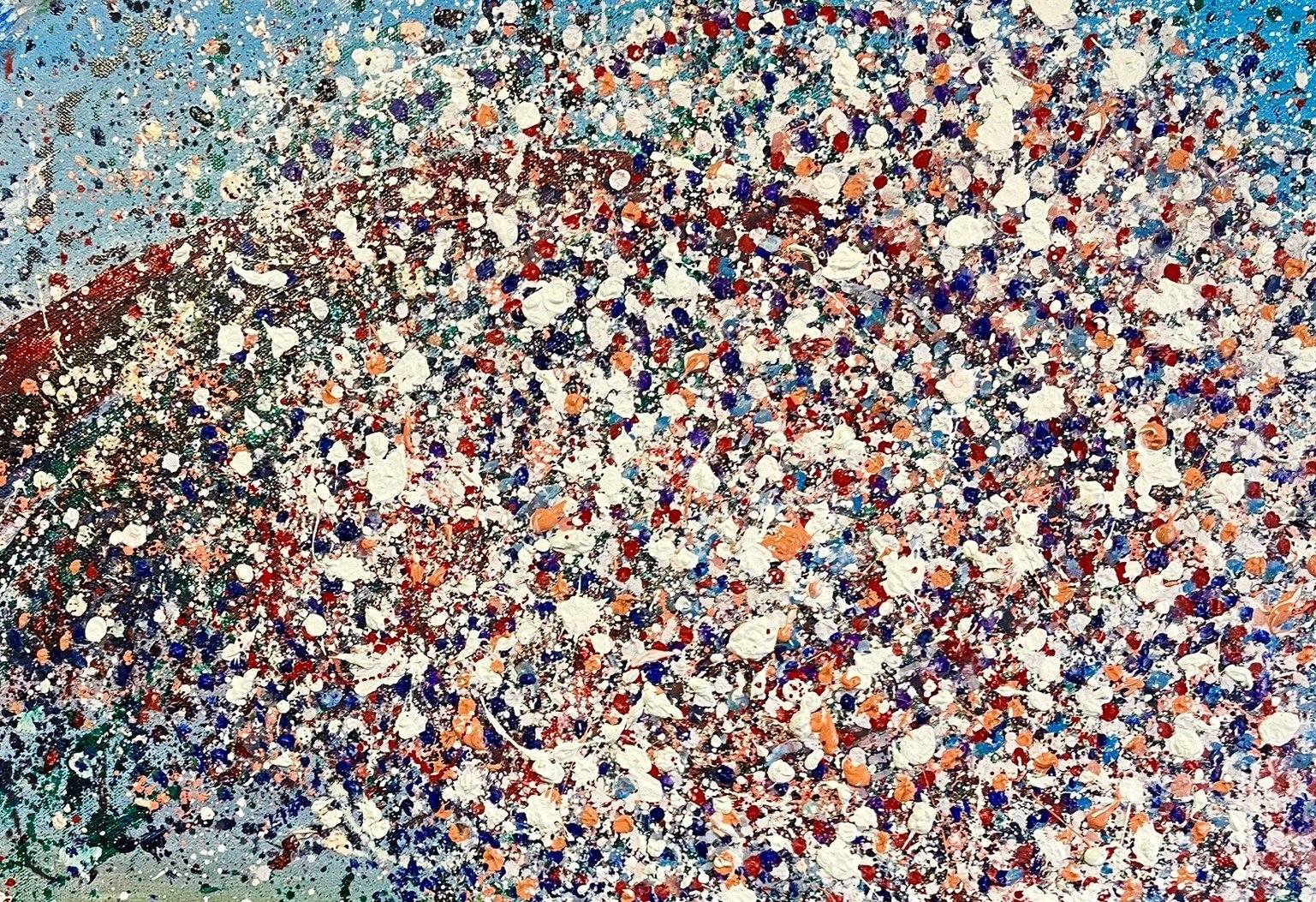
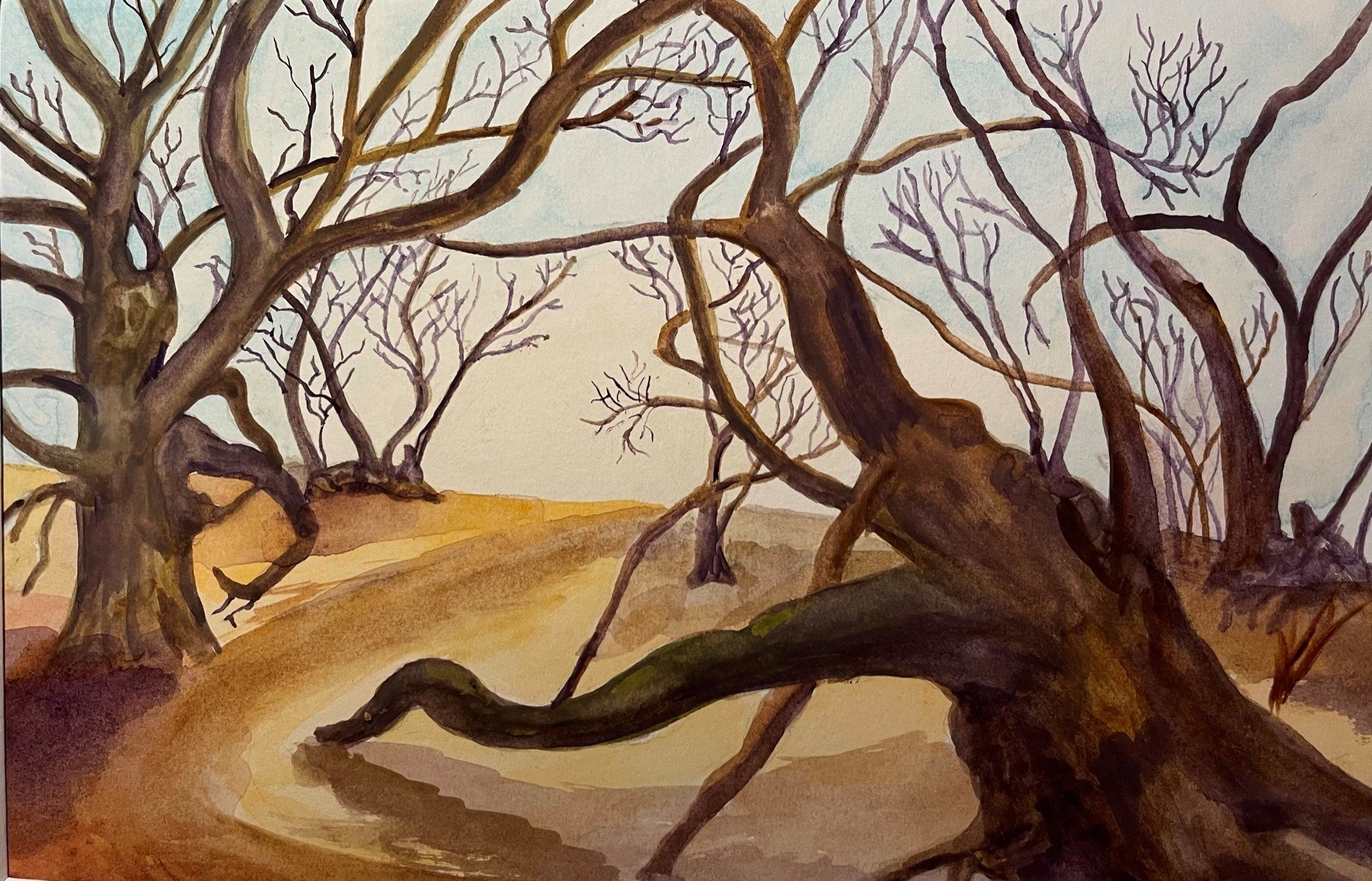
What do you see? How do you feel?
It All Begins Here
March 2026
Two people stand in front of the same painting.
Obviously, what they actually see is exactly the same.
But how they feel is probably very different.
So if 100 people look at one of my paintings, will there be 100 different reactions?
Maybe not – I have watched people wander through exhibitions of my work, and indeed I have posted a lot of images online, and it is clear in both situations that there is a consistency about those which gain no reactions at all. There is less consistency over which are well-received.
I have tended to take the view that the ‘blurb’ – the words I put out there with a painting – should not affect viewers’ reactions to the painting, but I am learning that actually those words are very important.
What I paint is an act of self-expression. I rarely attempt to transpose the scene in front of me directly onto the canvas like a photo, there are always choices to be made over composition, style, colours, light, brushwork etc, and so whatever is the final outcome - is mine.
SO – the ‘blurb’ should provide pointers to the viewer – what are you looking at / how should you judge it?
Without diving into psychoanalysis or arty mumbo-jumbo, it is obvious that, as with handwriting, something about the artist will be conveyed in the artwork.
Living in Wales, I know I am unusual in that I do not like Kyffin Williams’ paintings. There. I’ve said it. They are dark and moody, reflecting his own mental torments. Similarly, the 1950’s existentialists, Bacon, Freud et al, I find much too gruesome.
I look through galleries of photos of my paintings. Bright and colourful, lots of movement. I enjoy walking in the hills.
I suppose I fit into categories too – I am a ‘Boomer’, a child of the 1960s, I remember the ‘summer of love’, the Isle of Wight festival, flower-power, but I don’t believe that these can possibly define my art.