
Why we cannot all like everything
A painting is not simply a transposition of nature. It is the artist’s interpretation, an effort to present a fresh piece of creativity, something which will trigger a reaction in the viewer.
Which means that your judgement of a painting will not merely be the sum of the components (composition, colour, frame, media, technique….), but will include relational properties, some unique to you, some generated by your knowledge of the artist and some flowing from the context in which you are seeing the piece.
Our judgement of prehistoric cave paintings is very different from those we expect to see in major new exhibitions. We carefully read the bio-details about where and when the painting was created, the artist’s background and education.
We seek clues about what ‘it’ is that the painting is seeking to convey.
There are whole academic journals dedicated to the cultural interpretation of art – its ontology, its significance in relation to current societal themes, the artist’s place in the spectrum of humanity – philosophers from Socrates, through Hume, and Kant to Wittgenstein have codified the processes associated with judgement of aesthetics: are the ideas presented consistent or challenging in relation to current or past cultural trends?
I have to say that I doubt if many of the people who have gazed at my paintings had the slightest concern for these issues.
I am also fortunate in enjoying contact with a wide circle of fellow painters, and there too, I can say quite definitely that very few (if any) of those were consciously producing work as a comment on cultural themes!
So – which way up is this iceberg?
Is it the case that the public who look at art and the majority of artists who create it are merely unconscious of the reality that they are playing parts in a great cultural drama, or is it rather that the academic community have used their huge intellects to invent whole theories and disciplines to codify human behaviour?
One of the most basic questions facing an artist, and which then concerns the viewers, is about the degree of ’realism’ used in conveying an image – does the painting simply present exactly what is there to be seen, or to what extent should the artist interpret reality?
This most certainly is an issue of concern to the viewers of my paintings and to fellow artists. When I was a teenager, I drew a quick sketch of a little wood on the side of a hill. Someone looked over my shoulder then commented - “Hang on, that tree is in the wrong place” – he might have been joking, but the remark has stayed with me – what was I doing? Was it about the production of a precisely accurate image of the locations of each tree, a slavish following of nature, or was I producing a drawing that I would enjoy looking at?
It seems obvious to me that Picasso was correct when he made the assertion that ‘all art is abstract’ – if you are looking at a painting, you are not looking at the real world, you are looking at the artist’s interpretation of it. I have developed a firm belief that it is more important to end up with a composition that is pleasing rather than having each tree in precisely the ‘right’ place. And I was delighted to read a quote from Degas (who painted in his studio from memory) that he sought to ‘escape the tyranny of nature’.
Another was the surrealist Magritte “Ce n’est pas une pipe” – his title of a large painting of …. a pipe! (“It is not a pipe”) – ie, it is a painting.
Just as ‘the public’ have a broad spectrum of tastes, so too there are artists who take great care to paint precisely what they see while others use a very broad brush and produce art that conveys their feelings.
Delacroix proclaimed (in 1894 or so) that “the first priority of a painting is to be a feast for the eye….”
Now those academics have again written definitions and ‘abstract’ art has been put in a box and is regarded as that which does not seek to precisely mimic reality but rather will attempt to pick up some aspect(s) which will be evocative – the light, the colours, flow, shapes.
This is a challenge for those of us who seek to paint ‘landscapes’ and whose customers tend to purchase paintings of views which they recognise or which mean something to them.
The examples posted here demonstrate this – clearly these are based on Edinburgh, but no-one has ever seen precisely these views.
They are designed to be evocative rather than representational.
I know, and fully accept that this style will not be to everyone’s taste, but my point is that nothing will ever be to ‘everyone’s’ taste, as each of us is different!
Ce n’est pas Edimbourg!
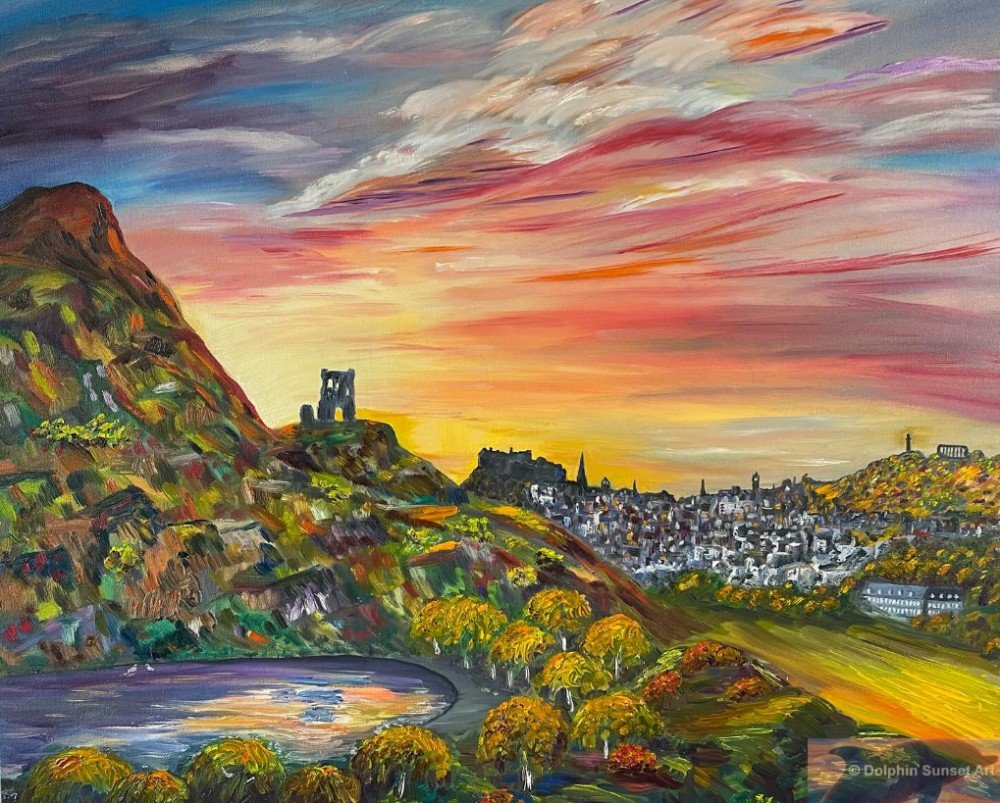
‘Holyrood Sunset’ 36” x 24”
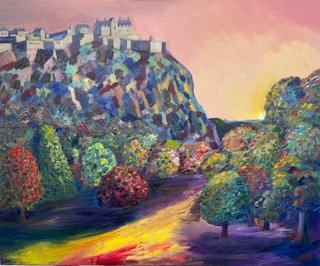
“Castle Rocks”
